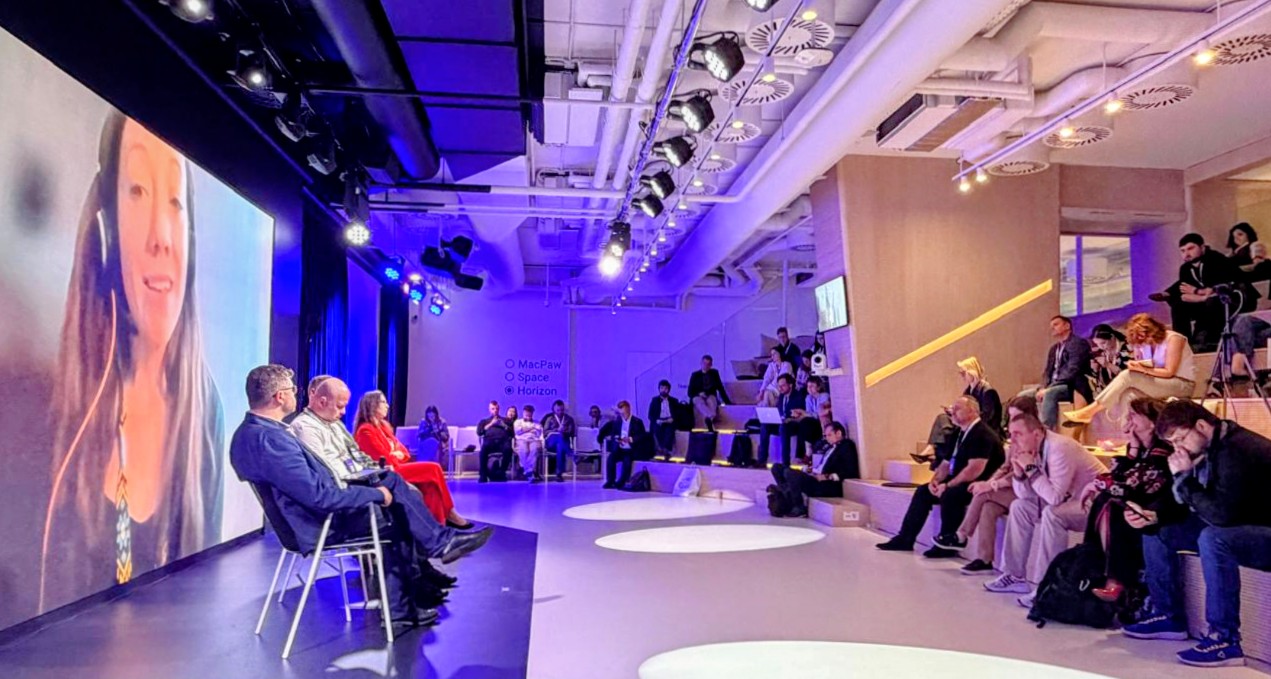
Our colleagues here today have already mapped the threat landscape and diverse response types with precision. I want to offer a different entry point with what I call the H2H — human-to-human methodology. What Oleksandra Matviichuk calls the human dimension of war.
Bombs destroy buildings. They don’t win wars. Popular will wins wars — and that begins with people. Ukrainians don’t need a foreigner to tell them this. But I raise it because it underlies cognitive and hybrid war: what ultimately determines the outcome is not just the ability to destroy, but the moral determination of a people not to be subjugated — and as people wearing many different hats, resisting in each context differently, you understand this more than anyone else in the world.
For the past 13 years I’ve been working on one of the oldest narratives in history: David and Goliath. From unarmed resistances across occupied Europe in the 1940s, to movements that eroded Soviet domination from within, to Solidarność in Poland, the Velvet Revolution, the Baltic chain… the pattern repeats. Populations without weapons, organized horizontally, deftly using backfire tactics to delegitimize aggressors in a sort of political jiu-jitsu, have historically held strategic advantage on the nonmilitary battlefield. Ukraine since 2022 is the foremost living example, though I would have preferred that this example had never existed.
What should be very unsettling is that Russia has felt its way around this same battlefield and is now extremely skilled, not only at countering civilian resistance, but at co-opting its tactics for perverse ends. Their means are not what violates our shared values; their ends are. Don’t mix means and ends. So, that advantage is now contested.
Foreign information manipulation and interference (FIMI) requires a void to fill. Where communities have strong horizontal trust, the will to remain free, and a strong history of nonviolent revolution, FIMI has a shorter landing strip.
My NGO here in Paris, the Organization for Nonviolent Movements, works at the intersection between civil society and national defense. Since we are based in France: Think of what we do as aerating aged wine so it expresses how it was intended to. We breathe in new oxygen: frameworks for understanding power, case studies from history and other geographical contexts, campaign planning tools. We aerate the strategic thinking of resisting communities, who are the aged wine themselves already. We hold up a mirror, reflecting back their actions to invite self-reflection. We build cross-border communities — not to instruct, but so people in similar situations can share knowledge, insights, and concepts for clearer strategic thinking on this nonmilitary, nonviolent battlefield — which includes the cognitive one. Governments and militaries don’t do this. Someone else has to, so there you have it: my purpose and the mission of my NGO.
We are stepping into this moment working with Ukrainian and international partners: co-creating unarmed resistance trainings with and for veterans; economic resilience teambuildings for corporate clients in Paris; and this fall, an edited volume with Ibidem Press and Columbia University Press on collective agency in national defense, amplifying the voices of Ukrainian civil society actors, prominent cultural figures, CIMIC (civil-military cooperation) officers, and veterans. We also have board members from STRATCOM in Kyiv and retired military, collaborations with NAKO Independent Anti-Corruption Commission, Business for Ukraine Coalition, Ternopil Pedagogical University, One Philosophy/Resilient Ukraine, and others across France and western Europe.
Since we are here to talk about cognitive resilience, let me tell you about how our work maps onto two categories of information tactics.
The first is centered on our hyperlocal networks of trust across Francophone Africa. ONM just launched a pilot survey on Russian influence and recruitment operations targeting Africans. Sobering findings: among what first comes to some respondents’ minds about Russia: not war crimes but instead “a global leader in medicine degrees.” Many believe third-party actors, not Russia, started the war in Ukraine. Recruiters presented as institutions, companies, consultants offering scholarships, training, employment via Facebook, WhatsApp, in-person meetings, and Africans who studied in Russia and returned to recruit friends and family.
In every case where a respondent tried to reach someone who had left, the conversation eventually went silent and the person who had left went missing. One described a young man from Beni, DRC — recruited through a fake scholarship, sent to fight in Ukraine, and reported killed. His father, having studied in Russia, had helped recruit him and after his son’s death, the father fled to another city, presumably out of shame. This is the human network Russia is operating, and it’s invisible to official actors… unless you are a Russian one, apparently. Otherwise, you are only visible to small NGOs working directly with those communities, like mine, or very astute and locally trusted journalists.
The second category of information tactics in our work is centered on Ukrainian civilians and grassroots civil society projecting their own cognitive presence: through film, theater, social media, and documentation of destroyed monuments and pillaged archives. The creative producer of the Resistance TV series by journalist Akim Galimov contributed to my forthcoming edited volume. I interviewed Olga Sagaidak, who told me about a project documenting Russian destruction of Ukrainian cultural heritage in the early months of the war. Ukraine is broadcasting on its own frequency, not merely defending one.
We know civil society holds this terrain. The question is how we activate and support it, how we can help counter the Russian weaponization of less visible, offline, local communities and civilians. The main question I grapple with every day is how civil society across Europe can better support yours here in Ukraine. I would very much welcome bilateral conversations about this.
Thank you.